
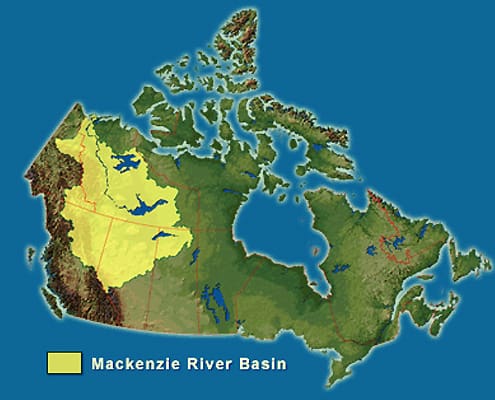
Ales Leads Major Study On Changes To the Mackenzie River Basin
BY HELEN METELLA
A six-year project headed by REES researcher Brenda Parlee and funded by SSHRC, will examine changes in fishing livelihood and aquatic ecosystems in the Mackenzie River basin, and document the impacts on the area’s 400,000 people.
A $2.3 million grant received by ALES researcher Brenda Parlee to study changes on the Mackenzie River Basin is a major milestone for the University of Alberta, as well as for international research.
The Social Sciences and Humanities Research Council’s prestigious Partnership Grant is the first one awarded to the U of A since they were established in 2013.
Parlee’s grant will fund a six-year project to track changes in fishing livelihood and aquatic ecosystems in the Mackenzie River Basin, and document the implications for the 400,000 people living there.
A closer study of this area — which covers almost 20 percent of Canada’s landmass, extending across the north of three western provinces plus two territories — is of global importance.
“The Mackenzie River Basin is one of the largest freshwater ecosystems in the world, a significant resource, particularly given concerns about drought, the sustainability of freshwater for drinking water, and the downstream effects of oilsands activity,” said Parlee, the Canada Research Chair for Social Responses to Ecological Change.
There’s increasing international concern on how to manage those issues better yet the Mackenzie is one of the world’s most understudied river basins.
The study is also noteworthy because most of its data will be gathered from community members, as researchers explore the valuable role of local and traditional knowledge in understanding many complex historical and contemporary issues of social and ecological change.
The central concern is with the long-term sustainability of fishing livelihoods in the Mackenzie River, which have long been key to the well-being of Indigenous communities across northern Canada.
Seasonal and year-to-year variability in the health of the river system necessitated the need to track the system’s natural variabilities and anomalies. Local practices of tracking change, known in the literature as community-based monitoring, continue to be important as Indigenous communities across the Mackenzie face growing pressures from climate change and resource development.
Around the world, Parlee said, such community-based monitoring is seen as a significant tool in maintaining the health and sustainability of ecosystems and communities, especially in the face of governments’ cutbacks to science research.
Parlee aims to advance understanding of its important role.
“We’re trying to build a toolbox for communities to do their own monitoring in the basin in a coordinated way,” said Parlee, who is also an associate professor in the Department of Resource Economics and Environmental Sociology.
“Our hope is to learn from each other about what works and what doesn’t, to help develop and contribute to policy and management of the pressing environmental issues … such as climate change and oil sands development.”
Researchers will train 60 to 80 students and community members over six years. Research nodes will also be established in Thailand and Brazil to exchange information with similar community-based projects working in the Lower Mekong River Basin and Lower Amazon Basin.
The study is centered at the University of Alberta but involves 12 other Canadian and international universities, 14 First Nations organizations, plus NGOs, governments, and other partners, including the Mackenzie River Basin Board’s Traditional Knowledge and Strengthening Partnerships Steering Committee.
In addition to the SSHRC grant, the project receives $416,000 of in-kind support from the U of A.
The study’s first step is to identify the places where Indigenous peoples feel there needs to be more research. A kick-off event for 2015-16 will be a traditional knowledge and science fair to which high school students from different areas of the basin will present research on areas important to them. It will take place in Edmonton next May.

I don’t think the title of your article matches the content lol. Just kidding, mainly because I had some doubts after reading the article. https://accounts.binance.com/sk/register?ref=WKAGBF7Y
Thanks for sharing. I read many of your blog posts, cool, your blog is very good.
Your article helped me a lot, is there any more related content? Thanks!
Thank you for your sharing. I am worried that I lack creative ideas. It is your article that makes me full of hope. Thank you. But, I have a question, can you help me?
Thank you for your sharing. I am worried that I lack creative ideas. It is your article that makes me full of hope. Thank you. But, I have a question, can you help me? https://accounts.binance.bh/register/person?ref=IHJUI7TF
I don’t think the title of your article matches the content lol. Just kidding, mainly because I had some doubts after reading the article.
Your article helped me a lot, is there any more related content? Thanks! https://www.binance.bh/register?ref=IHJUI7TF
Thanks for sharing. I read many of your blog posts, cool, your blog is very good. https://accounts.binance.com/register/person?ref=JW3W4Y3A
Thank you for your sharing. I am worried that I lack creative ideas. It is your article that makes me full of hope. Thank you. But, I have a question, can you help me?
I don’t think the title of your article matches the content lol. Just kidding, mainly because I had some doubts after reading the article. https://www.binance.bh/register?ref=JW3W4Y3A
Sangat setuju dengan penjelasan di atas, informasi yang sangat berharga. Untuk info akreditasi resmi dan biaya masuk prodi ini, referensi utamanya ada di jurusan broadcasting Jakarta. Dukungan biaya kuliah yang terjangkau dengan skema cicilan sangat membantu mahasiswa swasta saat ini. Terima kasih banyak, salam hangat. ID: CMT-M758YDCT0OFOIO2CHV
Thanks for taking the time to put this together.